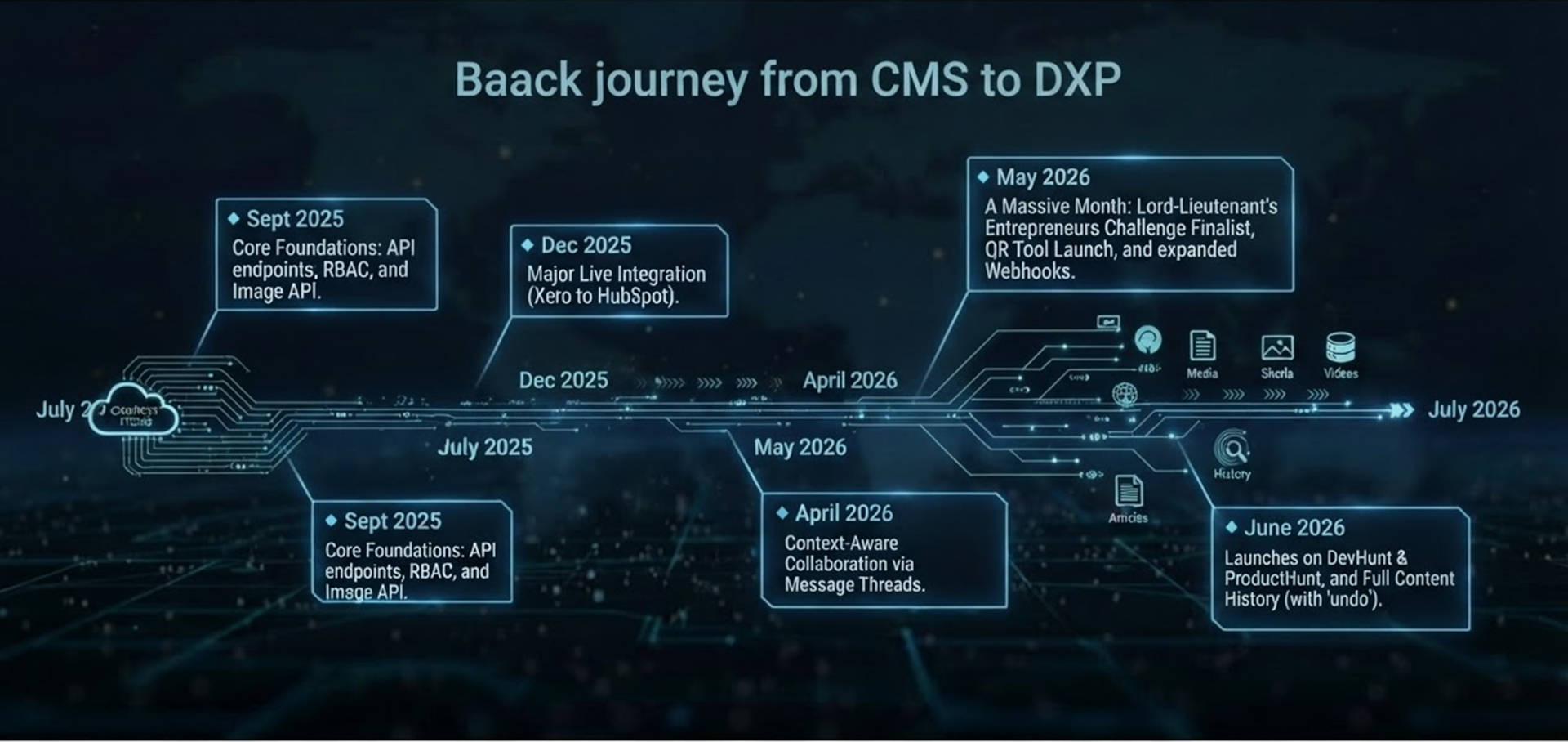
Celebrating one year of Baack is a major milestone in our journey from "heavy lifting" to providing a robust platform that empowers developers to build sophisticated digital experiences with speed and reliability. When we started, our goal was simple: eliminate the complexity of building digital products, allowing creators to focus on their core product challenges rather than backend plumbing.
As we celebrate our first birthday, let’s look back at how far we’ve come over the last twelve months.
The Baack Timeline: A Year of Growth
September 2025: Laying the Foundations
By September, just 45 working days in, we had already made significant strides in building our core capabilities. We focused on essential infrastructure, launching key API endpoints including:
- Core content type support for text, markdown, templates, and other primitive types.
- Companies entry point, Search (entities only), and Membership groups, which powered our pre-registration mailing list subscriptions.
- Role-Based Access Control (RBAC) with fine grained page entity support.
- A secure Image API with image edge caching.
- Initial Go-To-Market (GTM) experiments, exploring micro-app integrations like Xero-to-HubSpot synchronization.
Though our initial offering didn't cover every content type offered by competitors like Strapi Cloud or Contentful, we opted to focus on the features we needed ourselves. The market for headless content management is crowded, and we noticed many companies building their own CMS solutions accelerated by AI coding tools.
Our marketing adviser, a former CMO, had seen this route taken before. Their experience showed that custom-built solutions often increased the marketing team’s dependence on developers. This gave us the confidence to soldier on, knowing a space exists for a platform approach that creates a clean interface between marketing and engineering.
December 2025: Our First Live Integration
Early potential customers frequently asked for proof that the platform could scale. It’s a valid concern for any buyer looking to host their entire brand on a new content platform. To bypass the need for long-running integrations, we pivoted to building "one-click" apps that deliver instant value without the need for long-term buy-in. We scoured app stores for high-volume opportunities and were surprised to find that many common on-boarding integrations had poor reviews. With our experience in large-scale integrations, we knew we could do better.
By December, we successfully moved our first major micro-app 'Xero to HubSpot migration' into a fully live state with white glove support. This was a pivotal moment, proving our platform could handle real-world integrations at scale while stress-testing our database capacity and API performance (albeit with significant orchestration to avoid overloading partner platforms).
The systems we integrated had wildly different approaches to rate limiting, so we included a "sampling mode" to let users test results. Scheduling large migrations with hundreds of thousands of interdependent records was no small feat. It quickly became apparent that even for small businesses, we could easily hit Xero’s read limits and HubSpot’s push limits. Differences in data shapes often meant a single read from Xero resulted in hundreds of writes to HubSpot.
The systems we integrated had very different approaches to rate limiting so we included a sampling mode so that users could test the results. Scheduling large migrations with hundreds of thousands of records with inter-dependencies between them was no mean feat. While our platform could handle significant load it quickly became apparent that for even small businesses we would overload both Xero read rate limits ingesting and HubSpot pushes. The data shape differences between these two API often meant that a single read from Xero could result in tens or hundreds of writes to HubSpot. Then secure in our rich integration test suite, we’ve expanded to a fully self-service offering.
We were determined to build a genuinely 5-star experience. Making this process smooth for the user was key, providing continuous updates during migrations that could take hours. We succeeded, offering competitive introductory pricing by leveraging our platform’s speed to keep costs low. The only hurdle was the time required to polish the app due to insufficient documentation; we had to build based on live responses that were constantly evolving.
April 2026: Enhancing Communication and Performance
Spring brought a flurry of feature releases. We launched a preview of our highly anticipated Message Threads support, built on our existing group concept, enabling rich, context-aware collaboration.
We also achieved a significant performance boost, optimising our service to deliver content 30% faster by restructuring data under the hood, all without any breaking changes to the API surface.
May 2026: The "Technical Leap" and Community Engagement
May was a massive month for both visibility and technical capability.
- Engagement: We were finalists in the Lord-Lieutenant’s Entrepreneurs Challenge, where we showcased Baack's capabilities through a "Farm View" prototype and an interactive riddle app.
- Utility: We launched our free unbranded QR code generator, inspired by our own internal needs.
- The Technical Leap: We rolled out webhooks for over 80% of our API surface, featuring fine-grained subscriptions and standards-based authentication and security.
June 2026: Official Launch and Maturity
This month marks our official launch week! We aren’t just celebrating a birthday; we are celebrating a platform that has evolved from basic core services into a mature, event-driven, and highly resilient system. To cap off the year, we just released Full Content History, giving every creator the safety net they need to build without fear.
Looking Ahead
Our "API-first" approach has allowed us to iterate quickly and build a DXP that doesn’t just store data but actively facilitates complex, real-time collaboration.
From our first internal lines of code to supporting our first users, our progress has been driven by a desire to reduce "notification hell" solve the "cold start" problem for integrations, and provide a true backend for digital experiences on a silver platter.
Thank you to everyone who has been part of this first year. We’re just getting started, here’s to many more.